
An AI version of you, your voice, your writing, your look.
Keep as many versions as you like; exactly one is active per modality. Consent-first, own-voice-only, always.
Consent first. Then, and only then, likeness.
A twin built before you agreed to it is not a feature, it is a problem. The sequence below is the product sequence, not a marketing one.
- 01
You are asked
Explicit, recorded consent for voice and for likeness, separately.
- 02
The reference is yours
Your samples, your recordings. Withdrawing consent removes them.
- 03
The likeness resolves
Only after both of the above. Abstract here by design: we do not depict a real face in marketing.
- 04
The voice follows
The ribbon further down this page is the voice moment, and it takes the handoff from here.
Voice
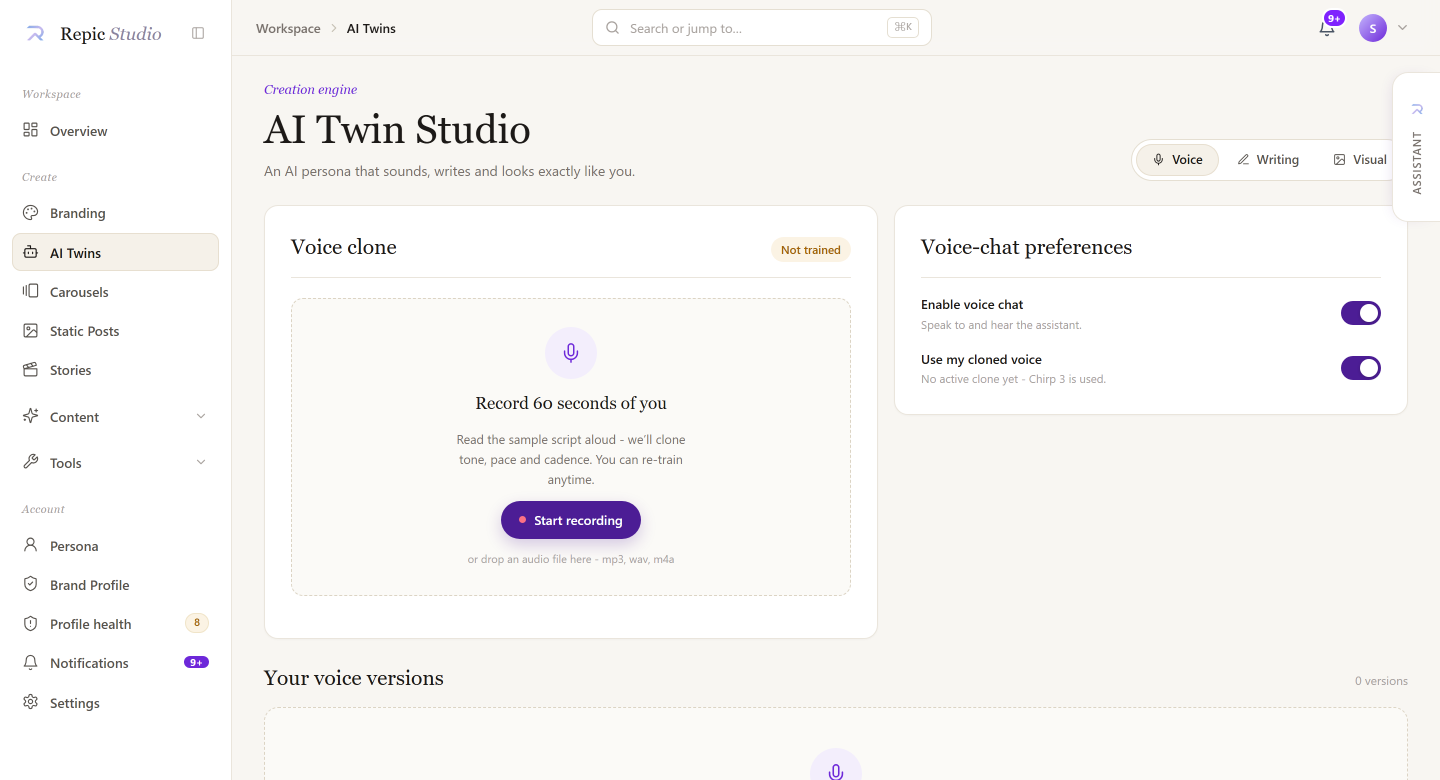
Clone your own voice, consent first, own-voice-only always. Use it for Voice Chat or narration, and retire it whenever you choose.
Writing
Train a writing twin on samples you provide. It learns your rhythm, your phrases, your no-go words, so drafts arrive sounding like you, not like a template.
Visual
A character sheet of your look, poses and expressions generated from your photos, with honest confidence labels on every angle.
Four steps. Consent is step one, not a checkbox.
Confirm the consent statement
On the recording screen, this is the gate everything else waits behind.
Record or upload your voice
A few minutes of natural speech is enough to start.
Processing
Your voice-cloning key never leaves our servers, and is never sent to your browser.
Your voice is ready
Activate it for Voice Chat, or keep it as one of your versions.
Consent-first, always: you can only clone your own voice on Repic. Every clone starts with an explicit consent step. Read our trust principles →
Talk to the Repic Assistant out loud, and hear it answer in your own cloned voice if you choose.
No clone active? It falls back to a studio voice, stated, never faked.
What this engine reads from your brand:
Real twins only.
These slots hold real sample-brand twins as they land, a character sheet and a labeled voice demo. Never staged, never a stranger's face. Status today: Live
For the detail-minded.
Versions & activation
Keep as many twin versions as you like, exactly one is active per modality (voice, writing, visual). Switch the active version anytime; delete any version anytime, and its data goes with it.
Voice data & keys
Your consent is recorded against the twin as proof the clone was yours to make. The voice-cloning key stays server-side, never sent to any browser. Full detail in the privacy policy's voice-data section.
Statuses & history
Twin training runs show honest statuses, and every version is listed with what it was trained on. Confidence labels on visual angles are real, not decorative:
3 min read · 6 sections
What an AI Twin is here, and what it refuses to be
An AI Twin is a model of one specific modality of you: how you sound, how you write, or how you look. Not a persona you invented, not a stock presenter, not a composite. You. That distinction is the whole product, and it is also why this engine has more restrictions on it than anything else in Repic.
Repic is consent-first by construction: voice and likeness twins require an explicit consent step and a spoken consent recording, the own-voice-only rule is enforced, and deletion actually deletes. Consent is a step in the product, not a clause in a document nobody reads: there is an explicit consent gate before a voice twin can be created, the consent itself is recorded in your voice, and the own-voice-only rule means you cannot train a twin on someone who did not sit down and agree.
Keep reading
You can keep as many versions of a twin as you like, because voices and looks are not one-shot decisions. But exactly one is active per modality at any time. That constraint exists so output is never ambiguous about which version of you it used, which matters the first time you need to answer that question about something that has already been published.
Step by step, with nothing skipped
Explicit consent, recorded
Before anything is trained you pass a consent gate and record a spoken consent statement. No consent recording, no twin. This is enforced in the product, not promised in the terms.
You provide your own material
Your voice, your writing, your likeness. The own-voice-only rule blocks training on third parties, which is the single most abused capability in this category.
The twin is versioned, not overwritten
Every twin you build is kept and labelled. Exactly one per modality is active, so every generated artefact traces to one known version.
Deletion actually deletes
Withdraw consent and the twin and its source material go. The biometric policy states what is held, for how long, and what deletion covers.
Voice twin versus voice clone
Before
A generic clone: upload thirty seconds of audio, get a synthetic voice, no record of who agreed to what, usable on anyone whose audio you can find.
After
A Repic voice twin: a consent gate, a spoken consent recording tied to the twin, an own-voice-only rule, one active version at a time, and deletion that removes the source material as well as the model.
The capability is similar. The gate around it is the product. If you publish a biometric policy and a DPA, the gate has to be real, because it is trivially checkable by anyone who cares to look.
What this does not do
It will not clone anyone but you
No celebrity voices, no colleague who "would not mind", no public-figure likeness. The own-voice-only rule is the point of the feature, not a limitation of it.
It is not a deepfake tool
Twins exist to let you produce more of your own work in your own voice. Impersonation of anyone else is prohibited by the Acceptable Use Policy and blocked by the consent gate.
It does not hide that it is generated
Repic does not encourage passing synthetic output off as unassisted work. Disclosure norms are covered in Trust and Safety.
Straight answers
What exactly counts as biometric data here, and what do you keep?
Voice and likeness material used to build a twin is treated as biometric data. The Biometric and Likeness Policy sets out what is collected, the consent gate it sits behind, how long it is retained, and your deletion rights, in specific terms rather than general reassurance.
Can I create a twin of my co-founder or a client?
Only if they go through the consent gate themselves, on their own account, with their own recorded consent. There is no path where you consent on someone else behalf, and that is deliberate.
Why only one active twin per modality?
So that any piece of output has exactly one answer to "which version of me made this". Keeping many versions is useful; having two of them simultaneously authoritative is how you end up unable to explain your own archive.
If I delete a twin, is my published content affected?
No. Deleting a twin removes the model and its source material going forward; work you already generated and published is yours and stays as it is. What ends is the ability to produce more from that twin.
Read next
- how Repic gates voice cloning behind recorded consent
- the difference between an AI twin and an AI avatar
- the Biometric and Likeness Policy in full
- Repic for coaches and consultants, who publish with their own face and voice
- the Trust and Safety rules we set before we needed them
- personal branding for speakers and experts
Stories
Vertical frames sized per platform.
Explore →Repic Assistant
Does the work, with your permission.
Explore →Consent-first voice cloning
How the consent gate inside voice twins works.
Explore →Free, no signup
Not ready to sign up? Run the brand voice generator instead.
Paste two or three things you have written and get a measured voice profile: sentence rhythm, register, who you address, plus rules and a rewrite.